Introduction
Forklifts and automated guided vehicles (AGVs) are the lifeblood of warehouse logistics and manufacturing material handling. However, the juxtaposition of heavy moving vehicles with pedestrians in tight aisles creates persistent collision risks. Our AI-based forklift safety platform adds an active visual intelligence layer to identify pedestrians entering defined danger zones in real time.
The Forklift-Pedestrian Challenge
Shared traffic zones become hectic during loading dock transfers, shift handovers, and material staging. While painted lines, convex mirrors, and warning horns help, operator blind spots—particularly when carrying high loads or reversing—remain hazardous. Human error, audible distractions from plant machinery, and pedestrian inattention frequently result in severe near-misses.
Creating Dynamic Virtual Danger Zones
Leveraging real-time edge processing from our video analytics architecture, YAFE establishes dynamic virtual safety zones around each vehicle:
- Proximity Zone (0–3m): Critical hazard perimeter. Immediate alarm sounding and optional vehicle speed governor activation.
- Warning Zone (3–5m): Yellow caution boundary alerting drivers and pedestrians of converging vectors.
- Blind Corner Monitoring: Overhead stationary cameras communicate with approaching forklifts to warn of hidden pedestrians around 90-degree aisle intersections.
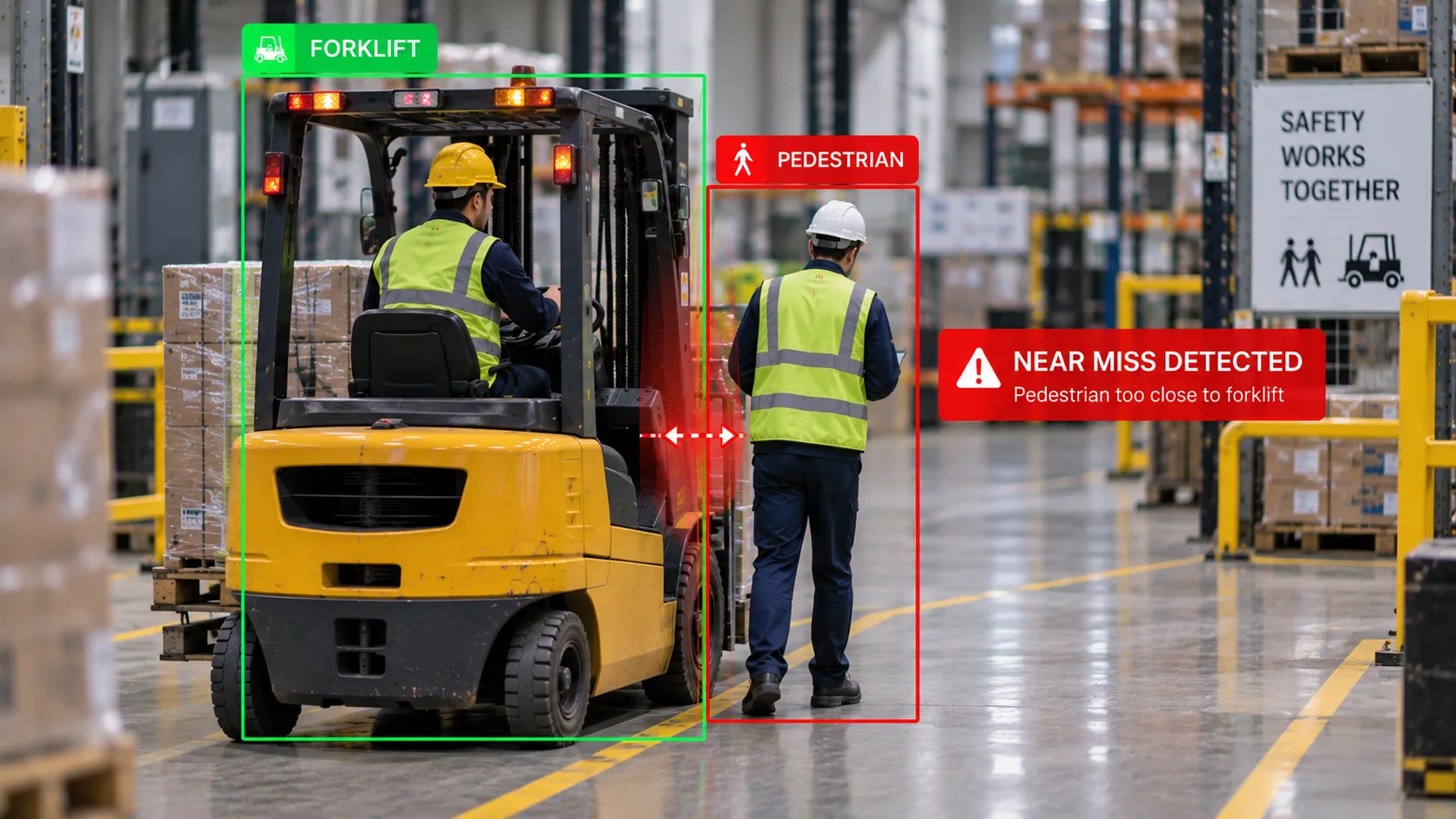
Improving Response and Driver Awareness
When a pedestrian crosses into a danger perimeter, the system triggers sub-second audio-visual alarms inside the forklift cabin and projects high-intensity ground lights onto the floor, alerting the worker to step back immediately.
Using Data for Prevention
Every near-miss event is geo-tagged and archived in the central safety dashboard. EHS managers can review heatmaps of near-miss hotspots to optimize aisle widths, install physical bollards, or schedule traffic light sequencing, driving systemic physical improvements rather than relying solely on driver caution.
By implementing YAFE Forklift Proximity AI across heavy foundry operations, Bradken achieved zero false alarms from non-human objects and eliminated forklift-pedestrian incidents across 18 months of continuous operation.
Deployment Best Practices
Successful deployment relies on combining vehicle-mounted ruggedized edge cameras with overhead junction surveillance. Calibrating AI models to distinguish moving workers from stationary pallets and equipment ensures drivers do not suffer from alarm fatigue.
Understanding Forklift Accident Statistics and OSHA Compliance
Industrial safety metrics and forklift accident statistics show that thousands of forklift accidents occur annually across global warehousing hubs, leading to tragic forklift fatalities. A recurring factor identified in forklift accidents OSHA reviews is pedestrian inattention and dangerous forklift blind spots around reversing trucks.
By upgrading from reactive passive signage to active forklift safety technology, facilities implement an end-to-end forklift collision avoidance system. Combining vision-based forklift safety systems with restricted zone intrusion detection and an objective plant safety AI platform comparison, plants ensure complete perimeter awareness without relying on expensive physical beacons.
Conclusion
AI-based forklift and pedestrian safety transforms reactive material handling into a proactive, accident-free logistics environment. Continuous visual awareness safeguards workers while maximizing material throughput, integrating with PPE compliance detection for holistic plant floor safety.
← Back to All YAFE Technical Insights