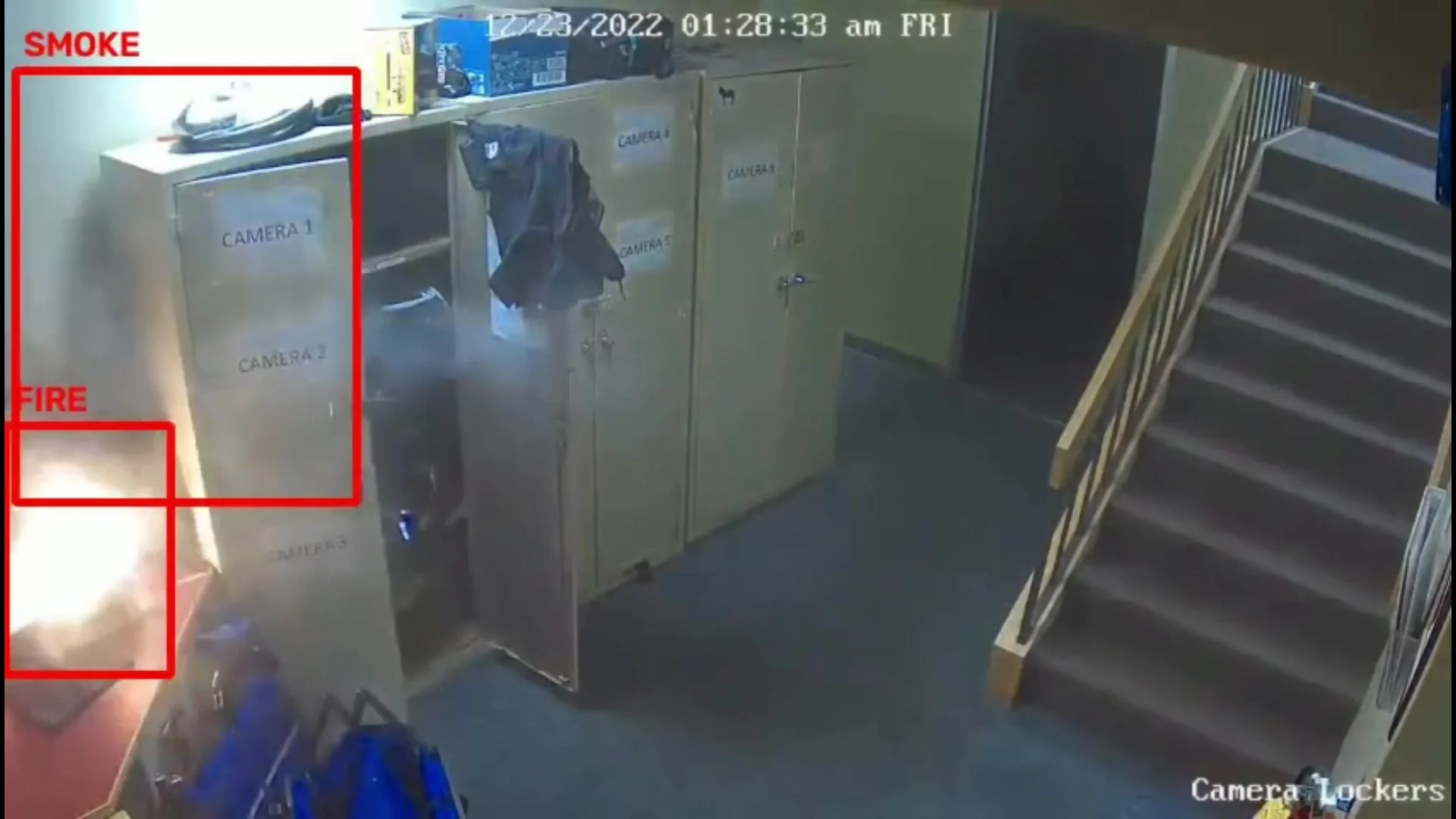
YAFE transforms standard plant CCTV into proactive visual fire and smoke detection (VFDS). Detect open flames, rising smoke plumes, and battery thermal runaway at the point of origin in sub-3 seconds — bypassing high-ceiling stratification barriers where traditional smoke detectors fail. Seamlessly synchronized with safe assembly muster roll-call, in-out occupancy tracking, and hazardous zone monitoring for automated plant-wide emergency intervention.
Traditional ionization and photoelectric ceiling detectors take minutes for hot smoke to reach high warehouse rafters. YAFE detects visual flame flicker and expanding smoke columns the instant they ignite.
Advanced convolutional neural networks recognize visible flame patterns, flicker frequencies (8–12 Hz), and intense thermal expansion in under three seconds directly from standard CCTV streams.
In facilities with ceilings over 10 meters, hot air layers create thermal stratification barriers that stop smoke from reaching ceiling sensors. YAFE video smoke detection operates at ground level with direct optical line of sight.
Filters out high-frequency industrial noise including steam valve blow-offs, diesel forklift exhaust, airborne dust clouds, metal grinding sparks, and welding arcs to eliminate costly false plant shutdowns.
On-premise edge appliances interface via Modbus, dry contact relays, and OPC-UA to trip automated sprinkler pre-action valves, shut off HVAC dampers to contain smoke, and broadcast plant sirens.
Instantly synchronizes with YAFE Safe Assembly Headcount Fire and Smoke Detection and In-Out Occupancy to compare pre-incident worker logs against assembled personnel, isolating trapped employees in seconds.
Maintains rolling pre-event video buffers that automatically archive the exact ignition root cause, assisting EHS safety managers, OSHA auditors, and insurance adjusters with incontrovertible visual records.
How YAFE Computer Vision autonomously orchestrates early fire intervention, building containment, and worker muster accountability.
High-resolution RTSP CCTV streams are ingested at 30 FPS. Visual neural networks detect micro-flames and smoldering aerosol plumes.
Temporal flicker filtering confirms authentic combustion, rejecting false triggers from welding arcs, dust clouds, or steam releases.
The edge box triggers dry contacts to trip pre-action sprinkler valves, shut HVAC dampers to starve oxygen, and sound alarms.
Cameras at safe assembly points count evacuees, cross-referencing in-out occupancy to pinpoint missing workers.
Compare response times, coverage versatility, and failure modes across commercial fire detection technologies.
| Performance Criterion | YAFE AI Video Detection (CCTV) | Ceiling Spot / Ionization | Aspirating Smoke (VESDA) | Optical Beam Detectors |
|---|---|---|---|---|
| Detection Speed | < 3 to 10 Seconds | 3 to 8 Minutes (Slow) | 30 to 90 Seconds | 1 to 3 Minutes |
| High Ceilings (>10m / Atriums) | 100% Unaffected (Optical LOS) | Fails (Thermal Stratification) | Moderate (Delayed Transport) | Fails on Building Sway |
| Outdoor Yards & BESS Bays | Fully Operational IP67 | Inoperable Outdoors | Inoperable (Tube Clogging) | High Fog/Sun Interference |
| False Alarm Mitigation | Deep CNN Noise Filter | Triggers on Dust & Steam | Triggers on Airborne Particulates | Triggers on Alignment Drift |
| Visual Proof & Incident Location | Real-time CCTV Feed + BBoxes | Zone Loop Number Only | Sampling Pipe Index Only | Beam Path Interruption Only |
| Hardware Infrastructure | Uses Existing CCTV Cameras | Requires Dedicated Conduit | Requires Expensive Pipework | Requires Transmitter/Reflectors |
Deploy AI fire and smoke detection where early warning is vital to protect lives, machinery, and business continuity.
Detect early off-gassing aerosols and thermal runaway flames in lithium-ion battery banks before devastating thermal propagation occurs.
Continuous monitoring of hazardous chemical distillation columns, paint spray booths, and flammable liquid dispensing zones.
Instant detection across 15-meter rack aisles where ceiling sensors remain completely blind until fire has consumed vertical inventory.
Sophisticated spectral filters differentiate between operational welding arcs and dangerous ignitions on nearby rags or wooden pallets.
Rapid detection of fast-spreading flash fires across combustible dust zones, chip piles, and cotton processing conveyor lines.
Weatherproof outdoor optical surveillance detecting arcing, bush fires, and oil-filled transformer dielectric fluid ruptures.
Key answers regarding NFPA standards, camera hardware requirements, and PLC integration.
YAFE connects directly to your existing IP security cameras over RTSP or ONVIF protocols. Our edge AI appliance analyzes video feeds at 30 frames per second using deep convolutional neural networks (CNNs). The model tracks flame color spectra, flicker frequencies, smoke opacity, and plume expansion rates to detect ignition in sub-3 seconds without replacing your existing camera hardware.
In tall warehouses (10–20 meters), hot air forms a ceiling thermal stratification layer that prevents cooler early smoke from reaching ceiling point detectors. AI visual smoke detection spots smoke plumes optically right as they leave the origin, saving 3 to 8 vital minutes before ceiling sensors even register a threat.
YAFE neural networks are trained on millions of real-world industrial video frames. The AI tracks temporal flicker dynamics, color dispersion, and edge diffusion to differentiate real flames and hazardous combustion from hot steam releases, dust clouds, diesel exhaust plumes, and welding torch arcs.
Yes. YAFE edge appliances include dry-contact relays, Modbus, MQTT, and OPC-UA connectivity. Once a flame is verified, the system can immediately activate pre-action deluge systems, close HVAC smoke dampers to contain toxic gases, sound plant sirens, and notify EHS officers via SMS and email.
Upon alarm trigger, YAFE synchronizes with Safe Assembly Point Head Count and In-Out Occupancy Monitoring. As personnel evacuate to muster zones, the system counts assembled workers and identifies anyone still unaccounted for, displaying their last known camera location to emergency first responders.