Introduction
Industrial safety research consistently indicates that over 80% of workplace incidents originate from unsafe behaviors and awkward physical ergonomics rather than equipment failure. While mandatory PPE detection mitigates damage when an incident occurs, behavioral AI and ergonomics aim to prevent dangerous conditions from ever forming.
Beyond Static PPE Checklists
Traditional compliance checklists focus on equipment presence because it is easy to audit visually. However, contextual risks—such as jumping down from loading platforms, walking while looking at mobile phones in active forklift traffic lanes, or breaching restricted machine hazard zones—represent severe latent hazards that standard audits miss.
Automated Biomechanical & Posture Scoring
Using 3D spatial joint tracking via our on-premise video analytics edge architecture, YAFE Ergonomics AI monitors operators during repetitive lifting, packing, and machine tending tasks. The system continuously evaluates posture against established clinical ergonomics standards:
- RULA (Rapid Upper Limb Assessment): Analyzes neck flexion, shoulder abduction, wrist twist, and forearm load.
- REBA (Rapid Entire Body Assessment): Evaluates whole-body musculoskeletal exposure during heavy material handling.
- Heavy Lifting Posture: Identifies rounded-back lifting versus proper knee-bend lifting mechanics.
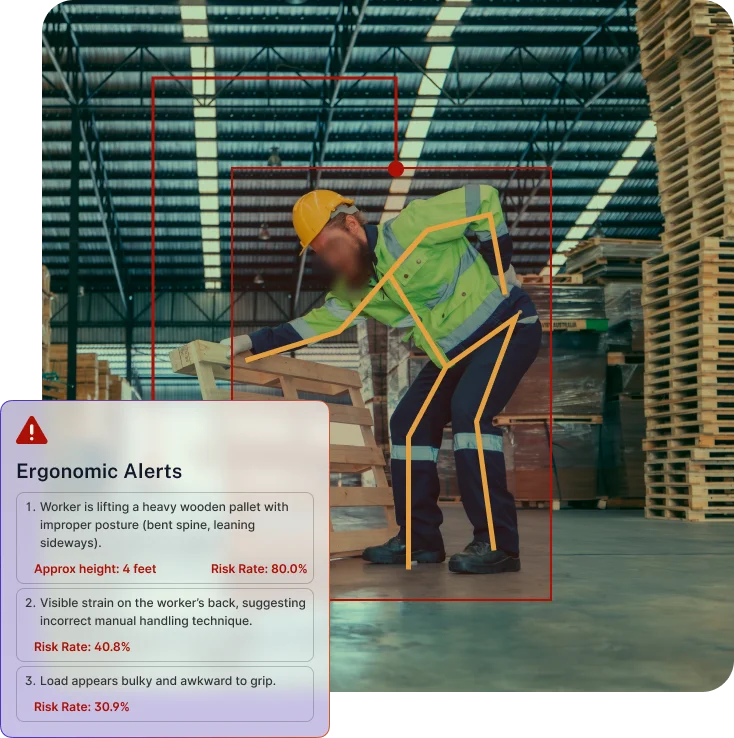
What Is REBA? (Rapid Entire Body Assessment Explained)
A common question among factory EHS professionals is what is REBA and how does it prevent workplace injuries? A REBA assessment (Rapid Entire Body Assessment) is an internationally validated postural analysis system developed to evaluate whole-body musculoskeletal risks during dynamic industrial tasks. By scoring postures of the wrists, forearms, elbows, shoulders, neck, trunk, and legs alongside load coupling and activity levels, REBA provides a single risk index from 1 (negligible) to 15 (critical).
RULA Assessment & Modern Ergonomics Software
While REBA examines the entire kinetic chain, a RULA assessment (Rapid Upper Limb Assessment) focuses on biomechanical demands imposed on the neck, trunk, and upper extremities. It is particularly crucial in electronics assembly, packing cells, and machine tending workstations where operators maintain sustained arms-raised postures.
Historically, completing these assessments required safety engineers to manually record clipboard observations and pause frame-by-frame video. Modern computer vision acts as enterprise ergonomics software and automated ergonomic risk assessment tools, transforming standard overhead CCTV cameras into continuous posture scoring engines that alert safety managers to excessive joint angles before cumulative trauma occurs.
From Behavioral Detection to Collaborative Coaching
AI behavioral tracking should never be deployed as punitive surveillance. When an unsafe shortcut or high ergonomic score is recognized:
- The worker receives immediate, discreet visual feedback at their workstation monitor.
- EHS teams analyze aggregated risk hotspots to evaluate whether assembly table heights need automated hydraulic adjustment.
- Repetitive strain injuries (RSIs) are prevented before chronic musculoskeletal disorders develop.
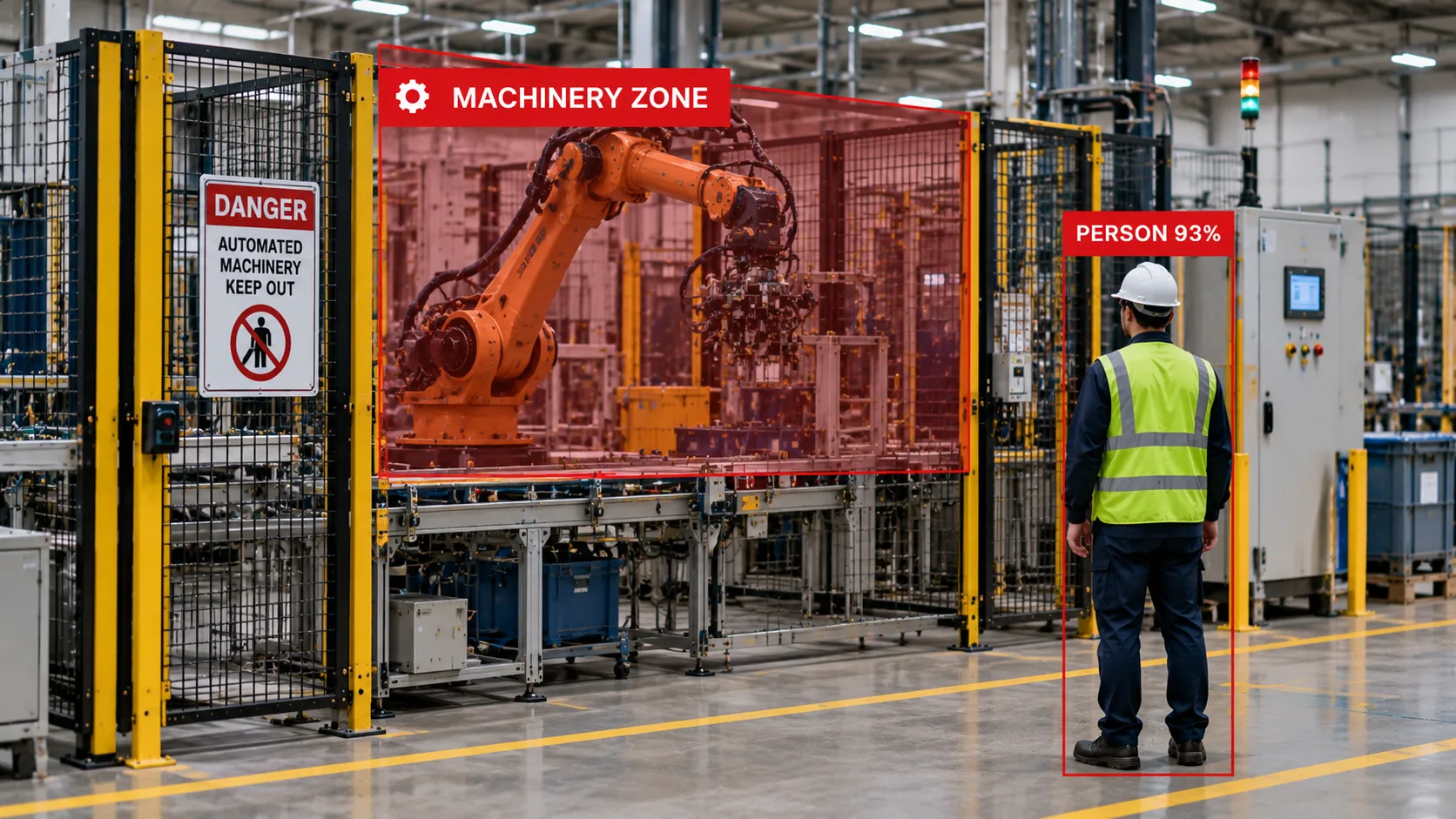
Manufacturing plants deploying YAFE Ergonomics AI report a 42% reduction in repetitive strain complaints and a 28% drop in absenteeism associated with lower back fatigue within 6 months.
Conclusion
Expanding plant safety from simple PPE monitoring to holistic behavioral intelligence across the Plant Safety AI Suite—combining ergonomic posture analysis with lone worker fall detection—protects workers from both acute traumatic accidents and cumulative musculoskeletal injuries, fostering a sustainable, world-class manufacturing workplace.
← Back to All YAFE Technical Insights