Introduction
Restricted zones are commonly used around hazardous machinery, maintenance activities, electrical equipment, chemical areas and other controlled spaces. Deploying AI restricted-zone intrusion detection creates intelligent virtual safety boundaries to identify unauthorized entry with zero physical trip hazards.
Why Restricted Zones Need Continuous Awareness
Physical chain-link fences and painted caution lines are critical, but physical gates are often propped open during shift work, and warning signs are easily ignored under tight production deadlines. Continuous video analytics bridges the gap between passive barriers and active real-time safety enforcement.
Creating Virtual Safety Boundaries
Powered by on-premises edge computing from our video analytics architecture, EHS administrators draw multi-point geometric exclusion polygons directly onto live camera feeds. Advanced spatial models distinguish between:
- Warning Zone: Perimeter buffer that triggers gentle audio warnings when a worker draws within 2 meters of the danger line.
- Exclusion Zone: Critical inner envelope that fires high-intensity sirens and sends an emergency stop signal to machinery PLCs.
- Directional Awareness: Differentiates between an authorized operator safely exiting an enclosure versus someone unauthorized attempting entry.
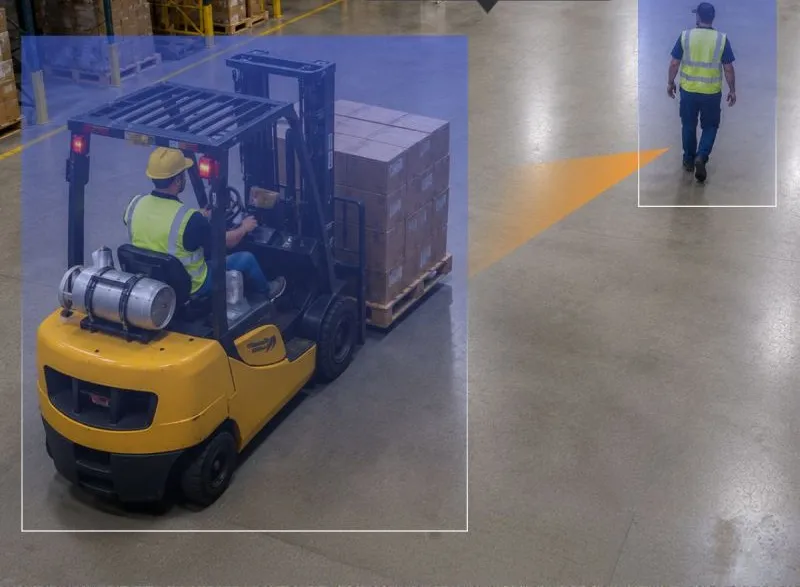
Supporting Faster Investigation & PLC Interlocks
When a boundary breach occurs, the system logs an immutable video clip and immediately actuates digital relay outputs connected to machine safety controllers, bringing hydraulic presses or robotic arms to a safe, controlled stop before injury can occur. This active perimeter protection pairs seamlessly with forklift pedestrian separation and overhead crane suspended load tracking.
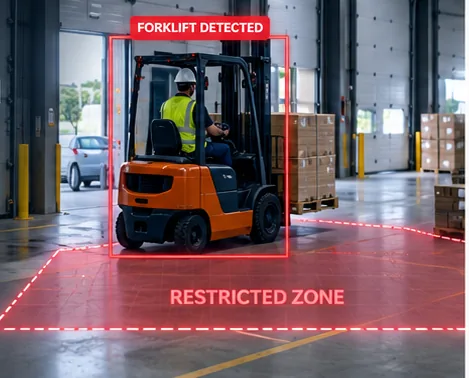
Deploying YAFE Restricted Zone Detection at JCB achieved sub-50ms alarm latency across automated welding bays, completely eliminating unauthorized worker entry during active robot sequencing.
Near-Miss Detection & Reporting in Hazardous Zones
In high-risk manufacturing environments, for every severe injury there are approximately 300 unreported near misses. Traditional incident logging relies on paper logs or delayed employee reports, leading to significant gaps in hazard visibility. YAFE functions as autonomous near miss software and an end-to-end near miss management platform that automatically captures every close call in real time.
By deploying computer vision for restricted zone intrusion detection, every time an employee enters an active hazard zone, the system logs the exact timestamp, coordinates, and duration. An instant hazardous zone intrusion alert notifies supervisors on their mobile devices and triggers local audible beacons. EHS teams gain a complete audit trail without burdensome manual paperwork. Learn more about configuring virtual safety fences on our dedicated Restricted Zones Intrusion Detection solution page.
Learning From Access Events
Historical breach records show recurring patterns. If operators consistently cut across a designated restricted corner to reach a tool crib, safety managers can redesign pedestrian walkways to eliminate the underlying temptation rather than continually penalizing workers.
Conclusion
Restricted-zone detection gives manufacturers a flexible, reliable way to add virtual safety boundaries to existing camera infrastructure. By uniting visual detection with machine automation across the Plant Safety AI Suite and enforcing PPE compliance monitoring, factories achieve robust containment of high-risk physical hazards.
← Back to All YAFE Technical Insights