The Evolution of Industrial Safety: From Static Cameras to Mobile AI Officers
In complex manufacturing plants, heavy engineering foundries, chemical refineries, and high-throughput distribution hubs, maintaining a continuous culture of workplace safety is among the toughest operational challenges. Traditionally, plant safety has depended on two pillars: static overhead CCTV cameras and manual human safety walkthroughs.
However, modern multi-acre production floors introduce structural hurdles that neither approach can completely solve:
- Severe Visual Occlusions: Overhead bridge cranes, high-density cantilever racking, mezzanine platforms, and oversized machinery cast massive blind spots over fixed cameras.
- Inspection Fatigue & Human Limitations: EHS safety officers cannot patrol every square foot of an active factory simultaneously. Manual audits are inherently periodic—leaving long blind windows between safety officer rounds.
- Hazardous Exposure: Sending human inspectors into confined aisles, volatile chemical storage bays, or active robotic automation cells introduces personnel to the very hazards they are trying to monitor.
- Lagged Violation Remediation: Even when a static camera spots a safety lapse, resolving the violation requires a supervisor to locate the worker, by which time an accident may have already occurred.
To eliminate these operational gaps, YAFE introduces a breakthrough in collaborative plant safety: the YAFE Autonomous Safety Inspection Robot (AMR)—operating as an automated, on-ground AI Safety Officer.
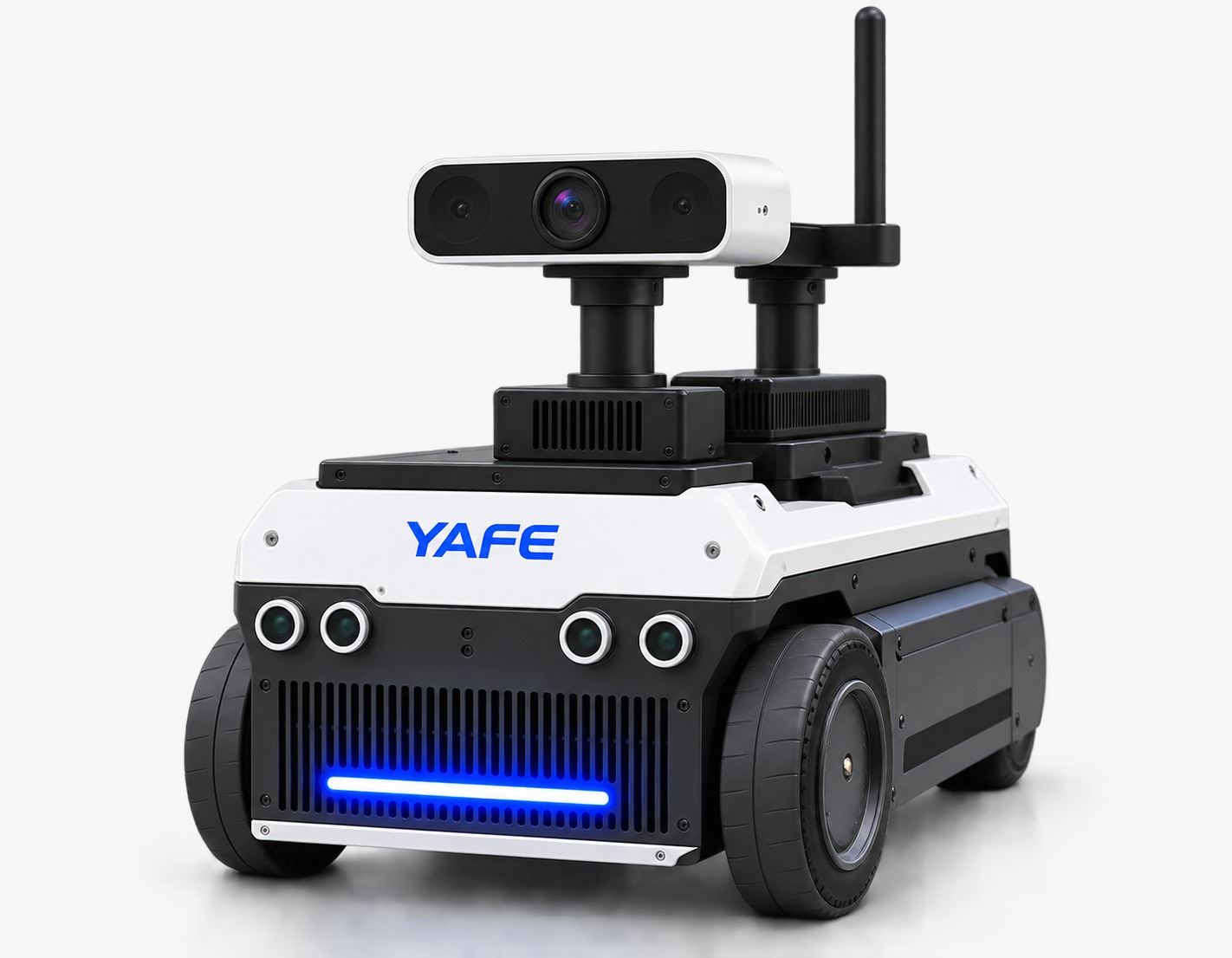
Equipped with sub-second neural inference, natural LiDAR SLAM navigation, and 360-degree sensor arrays, the YAFE AMR delivers Autonomous Operation, Intelligent Safety Checks, Real-Time Two-Way Interaction, and Automated Self-Charging without requiring infrastructure overhauls.
1. Intelligent Autonomous Patrol: "Always Moving. Always Monitoring."
The foundation of the YAFE inspection robot is its deterministic mobility system. Unlike human inspectors who are limited by physical stamina or fixed shifts, the AMR operates continuously across 24/7/365 production schedules under the principle of "Always Moving. Always Monitoring."
Scheduled vs. Randomized Patrol Routes
Safety managers can configure the robot's daily inspection mission profile using two distinct tactical patrol modes:
- Scheduled Patrols: Programmed routes designed around high-risk production milestones, such as shift changeovers, scheduled chemical transfers, raw material unloader staging, or scrap conveyor clearances.
- Random Patrols: Algorithmic, stochastic patrol patterns where the AMR varies its aisle transit sequences. This prevents workers from predicting inspection timing, eliminating the common pitfall where personnel only don safety gear when they know a supervisor is approaching.
- Automated Hazard Logging: Every anomalous condition detected during patrol—from oil puddles and tripping hazards to misplaced tooling—is geotagged to the plant's CAD floor plan and logged automatically into the EHS registry.
2. Live Two-Way Voice Interaction for Immediate Safety Compliance
One of the most transformative innovations engineered into the YAFE AMR is its real-time voice communication engine. While passive cameras can only record non-compliance for retrospective reprimands, the YAFE AI Safety Officer actively engages with workers on the spot to correct unsafe behaviors instantly.
How Real-Time Audio Engagement Works
When the robot’s computer vision detects an active worker in a designated safety zone who is missing required protective equipment, the robot immediately navigates within a polite conversational distance, faces the individual, and speaks:
"Please wear your safety helmet and hi-vis vest in this area."
Equipped with directional noise-cancelling microphone arrays that isolate human speech from heavy background factory noise (such as stamping presses or air compressors), the robot receives the worker's verbal confirmation ("Okay, I will wear them now") and pauses briefly to verify compliance before continuing along its patrol route.
Key Benefits of On-Floor Voice Interaction:
- Direct Intervention: Resolves safety violations in real time, preventing incidents before they occur.
- Non-Antagonistic Culture: Objective, polite, automated verbal reminders remove interpersonal friction between human supervisors and floor workers.
- Two-Way Emergency Communication: Workers can verbally notify the robot of localized plant emergencies or spills, which the AMR immediately relays to the central control desk with live video telemetry.
3. Emergency Safety Monitoring: Automated Critical Asset Auditing
OSHA and NFPA fire safety standards require regular visual inspections of emergency equipment. Yet, in practice, routine monthly checklist walk-throughs frequently miss sudden, dangerous violations—such as temporary pallets stacked directly in front of emergency egress routes.
Automated Fire Extinguisher Inspection
During its rounds, the AMR stops at every registered fire safety station:
- Presence & Placement Verification: Verifies that the fire extinguisher unit is mounted in its assigned bracket.
- Obstruction Detection: Confirms a minimum 36-inch (91 cm) clearance envelope in front of the extinguisher.
- Visual Inspection of Physical Readiness: Checks for missing safety pins, damaged discharge hoses, and orientation of pressure gauges.
Emergency Exit Clearance & Egress Route Monitoring
During active facility patrols, the robot continuously audits emergency exit doors. When logistics operators stage bulk cardboard boxes, wooden pallets, or empty chemical totes against emergency exit doorways, the AMR detects the obstruction within milliseconds, flags a high-priority "Blocked Exit" alert, and alerts the nearest material handler to clear the pathway immediately.
4. Working-at-Height Safety Monitoring: Scissor Lifts & Fall Protection
According to worldwide industrial accident statistics, falls from height remain the leading cause of fatal workplace injuries across construction, maintenance, and heavy industry. While ground-level PPE is relatively straightforward to inspect, auditing elevated personnel has historically required human supervisors to crane their necks upwards or climb viewing mezzanines.
The YAFE AMR solves this critical blind spot with its articulating high-angle vision turret:
- Full-Body Safety Harness Detection: Analyzes whether maintenance contractors working on aerial scissor lifts, cherry pickers, or scaffolds are wearing approved safety harnesses.
- Lanyard Anchor Verification: Inspects whether safety lanyards are properly hooked to rated overhead anchor points rather than dangling freely.
- Aerial PPE Verification: Confirms that elevated workers have chin-strapped hard hats and high-visibility vests secured before elevated maintenance commences.
The system actively differentiates between a compliant worker (Helmet, Harness, and Vest confirmed) and a worker committing a dangerous safety violation (such as an unfastened harness or missing lanyard anchor), triggering an immediate audio warning and supervisor notification.
5. Continuous PPE Compliance Monitoring Across Multi-Gear Classes
Personal Protective Equipment (PPE) is the final line of defense against workplace injury. Operating in coordination with YAFE’s stationary PPE detection system, the mobile AMR brings compliance auditing into every corner of the factory.
The robot’s onboard deep learning models detect four fundamental PPE categories in real time:
- Safety Helmet / Hard Hat Detection: Distinguishes standard safety helmets from baseball caps, turbans, or bare heads across dynamic lighting conditions.
- High-Visibility Reflective Vest Detection: Verifies reflective safety vests and high-vis jackets across class-2 and class-3 standards.
- Protective Safety Goggles: Identifies wrap-around eye protection in grinding, welding, and chemical splash areas.
- Industrial Safety Shoes: Audits required steel-toe boots and footwear standards in heavy manufacturing zones.
6. Restricted Zone Monitoring & Virtual Geofencing
High-voltage transformer rooms, active robotic welding cells, continuous coil slitting lines, and hydraulic press envelopes require strict access control. Traditional physical cages and optical light curtains are effective at their point of installation, but cannot protect temporary danger perimeters during maintenance outages or dynamic machine reconfigurations.
The YAFE AMR projects an intelligent virtual boundary around high-hazard work cells. When an unauthorized worker attempts to bypass a perimeter gate or enter a dangerous robotic operating radius:
- The robot spots the breach within sub-100 milliseconds.
- It triggers an immediate localized audio alarm and flashing strobe light to warn the worker to back away.
- It transmits an optional dry-contact or fieldbus interlock command to pause the nearby machinery through our restricted zone detection architecture.
- A timestamped incident report with HD video capture is logged into the safety database.
7. Inside the Machine: Industrial Hardware & Component Anatomy
The YAFE Autonomous Safety Inspection Robot is engineered from the ground up to thrive in punishing industrial environments. It combines automotive-grade chassis durability with cutting-edge edge AI computing hardware.
Component Breakdown:
- Sensor Module (Top Turret): House high-dynamic-range stereo cameras, pan-tilt zoom optics, high-frequency 3D LiDAR, environmental air sniffers, and dual high-gain industrial Wi-Fi / 5G antennas.
- Upper Protective Cover: IP65-rated industrial composite shell designed to shed coolant mist, metal dust, and airborne debris. Features 360-degree high-intensity blue status LED lighting bars for long-range visibility.
- Compute Unit: A ruggedized on-chassis edge neural processor equipped with dedicated GPU tensor cores. Performs all deep-learning inference locally with sub-20 millisecond latency, ensuring safety checks continue without cloud dependency.
- High-Capacity Battery Pack: Industrial Lithium Iron Phosphate (LiFePO4) battery chemistry providing extended multi-hour continuous patrol runtimes with rapid charging resilience.
- Heavy-Duty Chassis & Wheels: 4-wheel independent drive and suspension system capable of rolling smoothly over expansion joints, threshold plates, floor drains, and minor aisle debris up to 25mm height.
- High-Output Rear Speaker: Tuned acoustic transducer delivering high-clarity voice broadcasts that cut cleanly through 85+ dBA ambient plant noise.
8. Autonomous Self-Charging & Intelligent SLAM Navigation
True automation means zero maintenance overhead. The YAFE AMR is designed to run in continuous multi-shift plants without requiring dedicated human handlers.
Key autonomous operational behaviors include:
- Automatic Return to Charging Station: When state-of-charge drops below 20% or when its inspection schedule enters a shift pause, the AMR autonomously routes back to its floor-mounted docking station and mates with the charge contacts.
- Self-Charging Capability: High-efficiency DC charging recharges the pack rapidly while internal thermal monitors protect battery health.
- Intelligent Dynamic Obstacle Avoidance: If a forklift drops a wooden pallet in the aisle, or if floor workers congregate in an intersection, the robot's real-time SLAM recalculates a safe bypass trajectory with smooth deceleration.
- Automatic Patrol Resumption: The millisecond charging is complete or the next patrol interval triggers, the robot leaves the dock and picks up its inspection sequence automatically.
9. Modular Sensors & Customization for Your Facility
Different manufacturing industries face fundamentally different environmental hazards. A tire curing facility requires thermal monitoring; a chemical refinery requires volatile gas leak detection; an electronics assembly plant demands precision air particulate cleanliness.
Modular Payload Options:
- AI Optical Vision Camera: High-definition RGB imaging for PPE detection, safety gear classification, and structural defect recognition.
- Thermal Radiometric Camera: Continuously scans electrical distribution panels, pump bearings, hydraulic manifolds, and steam traps to identify abnormal hotspots and fire runaway risks before catastrophic breakdown.
- Precision LiDAR (Navigation & SLAM): High-density 360-degree point clouds ensuring millimeter-accurate localization in vast, dynamic warehouses.
- High-Fidelity Audio Module: Directional two-way speech, acoustic near-miss horns, and machine anomaly listening (identifying abnormal bearing squeal or air pressure leaks).
- Gas & Air Quality Sensors: Detects fugitive emissions of hazardous gases (CO, CO2, VOCs, ammonia, and flammable vapors) along chemical piping corridors.
- Environmental Sensors: Monitors ambient temperature, humidity, and barometric pressure for cleanroom and food-grade compliance.
10. Real-Time Telemetry, Safety Analytics & EHS Dashboard
Mobile inspection data is only as good as the insights it delivers. The YAFE robot feeds telemetry directly into an intuitive, web-accessible industrial dashboard and companion mobile app.
Through the unified monitoring interface, safety leaders gain complete operational transparency:
- Live Fleet Status: View real-time AMR positioning on the factory CAD layout, current patrol route progress, and live high-definition video feeds.
- Instant Multi-Channel Alerts: Real-time push notifications sent to mobile phones, smartwatches, and EHS command screens the second a critical safety breach occurs.
- Automated Inspection Reports: Generates daily and weekly shift compliance audit logs ready for ISO 45001, OSHA, and corporate EHS audits.
- Predictive Risk Analytics: Identifies recurring safety bottlenecks—such as specific bays where workers frequently remove PPE or doors that are repeatedly blocked by logistics staff.
11. Client Trials & Commercial Launch Timeline
The YAFE Autonomous Safety Inspection Robot is not a theoretical concept—it is an active, production-proven industrial product currently undergoing intensive client trials across tier-1 manufacturing facilities.
During active trial deployments in heavy manufacturing environments:
- Real-World Stress Testing: The robot has completed thousands of autonomous patrol kilometers across active assembly lines, forklift transit aisles, and welding shops.
- Performance Validation: Consistently achieving >99% PPE detection accuracy, sub-100ms obstacle avoidance reaction times, and zero human patrol intervention.
- Launching in One Month: Commercial orders and multi-site enterprise rollouts will officially open in one month. Early pilot booking is currently available for qualifying manufacturing and logistics facilities.
12. Industrial AMR Robots: Transforming Manufacturing, Warehouses & Assembly Lines
As global manufacturing accelerates toward Industry 4.0, AMR robots (Autonomous Mobile Robots) have evolved from simple automated guided carts into intelligent, cognitive agents. Today, leading autonomous mobile robot manufacturers are redefining operations by combining material logistics with real-time computer vision safety auditing.
Modern industrial autonomous mobile robots serve as the technological backbone across three critical operational pillars:
AMR Robots for Manufacturing & Factory Automation
Deploying AMR robots for manufacturing and AMR for factory automation bridges the gap between stationary production machinery and dynamic human workflows. Unlike legacy automated guided vehicles (AGVs) that rely on magnetic floor tape or embedded wires, next-generation autonomous robots for factories utilize natural LiDAR SLAM navigation to maneuver freely through crowded corridors. In heavy production plants, these smart factory mobile robots continuously audit machinery perimeters, identify tripping hazards, and enforce safety protocols alongside active human workcells.
AMR for Assembly Line & Automotive Industry Operations
In high-velocity assembly settings—particularly AMR for automotive industry and AMR for assembly line applications—tactical precision is paramount. Automotive stamping shops, engine sub-assembly bays, and body-in-white cells present continuous risks where workers operate close to robotic weld cells. Here, industrial AMR robots navigate directly along the assembly flow, auditing worker PPE adherence, verifying safety interlocks, and detecting blocked emergency egress doors in real time.
Autonomous Warehouse Robots & Material Handling Systems
Logistics managers increasingly deploy AMR robots for warehouse facilities and comprehensive autonomous material handling systems to accelerate intra-facility movement. While dedicated material handling robots and factory material handling robots transport raw components, work-in-progress (WIP), and finished pallets, mobile inspection units act as industrial logistics robots that patrol shared aisles. They monitor forklift blind spots, inspect overhead cantilever racks for structural damage, and ensure fire escape corridors remain 100% unobstructed.
Buyer's Guide: Evaluating AMR Robot Manufacturers, Suppliers & AMR Robot Price
For plant directors, operations vice presidents, and EHS executives selecting AMR solutions, evaluating AMR robot suppliers requires analyzing both hardware capability and total cost of ownership:
- Understanding AMR Robot Price & ROI Factors: The baseline AMR robot price typically ranges based on payload rating, drive mechanism, and specialized sensor payloads (e.g., dual LiDAR, radiometric thermal imaging, edge AI neural accelerators). However, enterprise buyers must evaluate the return on investment: by operating 24/7 across multiple shifts without human fatigue, a single autonomous inspection robot routinely pays for itself within 6 to 12 months by preventing catastrophic machinery fires, eliminating OSHA citation penalties, and cutting insurance liabilities.
- Onboard Edge Compute vs. Cloud Latency: Top-tier AMR robot manufacturers engineer on-chassis edge neural inference to guarantee sub-20ms hazard reactions without depending on plant Wi-Fi connectivity.
- Fleet Interoperability & Standardization: Premier industrial mobile robots support open communication protocols (such as VDA 5050, MQTT, and OPC UA), allowing seamless fleet synchronization with existing warehouse management systems (WMS) and manufacturing execution systems (MES).
Technical Comparison: Fixed CCTV vs. Human Audits vs. YAFE AMR
| Capability / Metric | Traditional Fixed CCTV | Manual Safety Walkthroughs | YAFE Autonomous Safety Robot |
|---|---|---|---|
| Coverage & Blind Spots | Fixed view; blocked by cranes, racks, & walls | Spotty; covers only where human walks | 360° Dynamic Mobility; zero blind spots |
| Inspection Frequency | Continuous (Passive recording) | 1–2 rounds per shift (Infrequent) | Continuous 24/7 autonomous patrol cycles |
| Working-at-Height Auditing | Rarely effective (camera angle is fixed) | Difficult to see anchor points from ground | Upward-tilting AI turret checks harness anchors |
| Emergency Asset Inspection | Requires manual review of footage | Manual clipboard paper checklists | Automated daily fire door & extinguisher audits |
| Real-Time Worker Interaction | None (Silent recording) | Subjective; creates supervisor friction | Objective, polite two-way voice prompts |
| Hazardous Area Entry | Cannot enter unmonitored zones | High risk to human inspectors | Explores volatile, restricted, or toxic zones safely |
| Self-Operating Autonomy | Requires human monitor to watch screens | Requires full-time dedicated staff | Autonomous SLAM navigation & auto-charging dock |
Frequently Asked Questions (FAQ)
What factors influence AMR robot price, and what is the typical ROI?
The AMR robot price varies based on the vehicle's chassis payload, battery capacity, and integrated sensor suite (such as radiometric thermal cameras, multi-plane LiDAR, and edge AI compute units). Unlike passive monitoring systems, the return on investment for industrial AMR robots is typically achieved within 6 to 12 months by preventing catastrophic equipment downtime, eliminating OSHA non-compliance penalties, preventing near-miss collisions, and providing continuous 24/7 patrol coverage across multi-shift facilities.
How do AMR robots for manufacturing operate alongside material handling robots?
Modern smart factory mobile robots utilize open fleet management standards (such as VDA 5050 and ROS 2) to co-exist harmoniously with existing material handling robots and factory material handling robots. The inspection AMR continuously maps dynamic obstacle vectors, actively yielding right-of-way to heavy transport vehicles while auditing transit aisles to ensure shared pathways remain safe for pedestrians.
Why are specialized AMR solutions preferred for the automotive industry and assembly lines?
In high-throughput sectors like AMR for automotive industry and AMR for assembly line plants, operations require zero-downtime reliability and instant hazard mitigation. Leading AMR robot suppliers provide robots with on-chassis edge AI that detects safety violations, working-at-height harness compliance, and restricted zone breaches in sub-20ms time, speaking directly to workers to prevent injuries before assembly lines halt.
What is the YAFE Autonomous Safety Inspection Robot?
The YAFE Autonomous Safety Inspection Robot is a mobile, AI-powered Autonomous Mobile Robot (AMR) designed to serve as an on-ground AI Safety Officer. Powered by LiDAR SLAM navigation and localized edge neural vision, it autonomously patrols industrial facilities, enforces PPE compliance, inspects critical emergency assets, audits working-at-height harnesses, and communicates verbally with personnel in real time.
How does two-way voice interaction work in noisy factory environments?
The robot features an integrated multi-microphone array with industrial active acoustic noise suppression and a directional high-output rear speaker. It delivers clear voice safety instructions directly to workers (e.g., reminding them to put on safety helmets or vests) and allows workers to acknowledge instructions verbally or request assistance, even amidst heavy machinery noise.
How does the robot monitor working-at-height safety on scissor lifts and scaffolding?
Equipped with an upward-tilting, high-resolution optical sensor module, the AMR scans elevated personnel on scissor lifts, boom lifts, and maintenance scaffolds. The neural network detects whether full-body safety harnesses are properly secured and anchored to certified tie-off points, issuing instant alerts if an unanchored harness violation is detected.
What happens when the robot's battery runs low during an active patrol mission?
The robot operates completely independently. When its battery reaches a designated minimum threshold, it automatically pauses its patrol and returns to its dedicated docking station for self-charging. Once recharged, it autonomously resumes its inspection route from the exact location where it left off, requiring zero human intervention.
Can the robot integrate with existing plant MES, EHS, and emergency dispatch systems?
Yes. YAFE's inspection robot provides bi-directional API and MQTT connectivity that syncs directly into plant Manufacturing Execution Systems (MES), enterprise Environmental Health and Safety (EHS) dashboards, and mobile alert channels, logging timestamped photographic evidence of violations for compliance audits.