Introduction
With the increasing complexity of manufacturing processes, ensuring that every part of the assembly process is carried out consistently has become difficult. If any part of the assembly process is missed—such as a missing screw, an unclipped harness, or a component fit incorrectly—it can negatively impact product quality, cause expensive rework, and create severe assembly line delays.
With AI Assembly Tracking, manufacturers can track and verify assembly processes more efficiently than ever before. Using computer vision and digital SOPs, shop floors can autonomously monitor human and robotic tasks using artificial intelligence.
Components can be tracked, assembly steps completed, and any discrepancies identified before the part ever moves down the production line. Using AI Assembly Tracking helps manufacturers establish complete visual visibility across every active workstation.
What is AI Assembly Tracking?
AI Assembly Tracking uses industrial optical cameras and computer vision alongside deep-learning logic to monitor assembly operations in real time.
The camera observes a designated workstation area and identifies whether required components, tools, and assembly conditions are present. This is achieved by analyzing video frames at high frame rates. Real-time conditions are dynamically compared against pre-defined digital assembly instructions to determine if an assembly step can be considered complete.
As opposed to having supervisors manually shadow operators with clipboards, AI Assembly Tracking delivers instant, real-time visual feedback directly to the operator at the workstation.
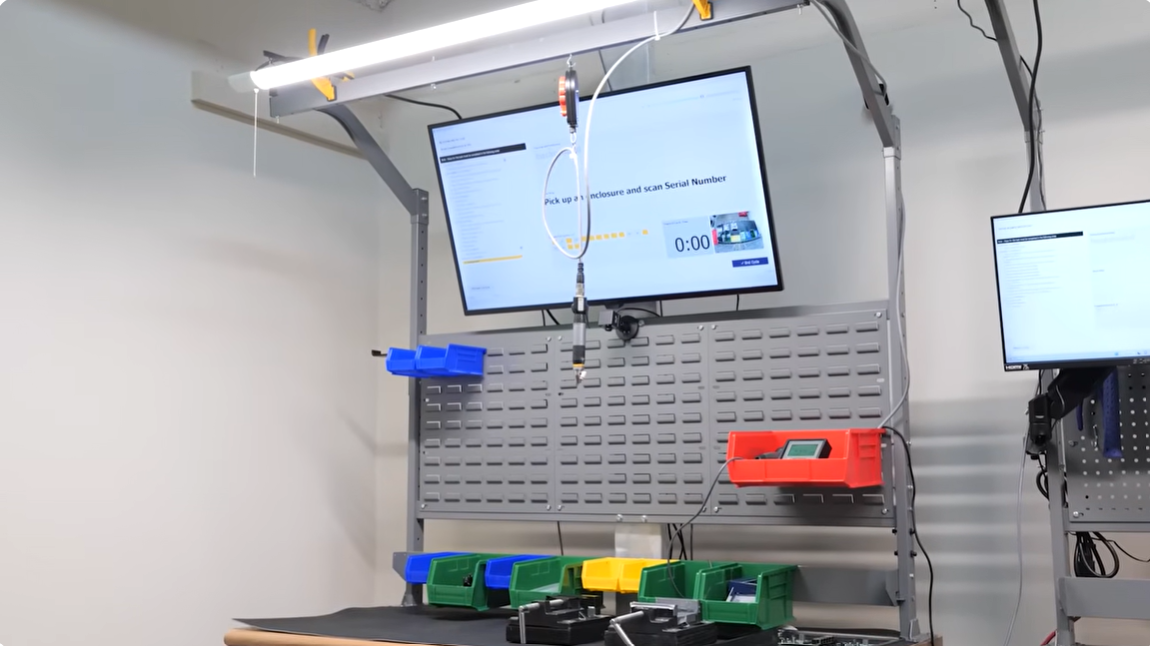
The assembly tracking solution is deployed across a variety of industrial applications, including:
- Component Identification: Identifying raw parts, circuit boards, brackets, and sub-assemblies before placement.
- Screw & Fastener Identification: Checking whether screws, bolts, clips, and rivets are present in the correct coordinates and quantities.
- Tool Identification: Validating that specific tools (such as torque drivers, riveters, and scanners) are engaged in the correct sequence.
- SOP Step Tracking: Automatically stepping through digital instructions as physical conditions are verified.
- Discrepancy Highlighting: Instantly flagging missing parts, incomplete insertions, or out-of-order execution.
- Assembly Progress Dashboard: Displaying pending, in-progress, and verified completed steps on operator-facing screens.
The exact functionality is tailored based on camera placement, model accuracy, ambient lighting, and component visibility across the fixture.
How Does AI Assembly Tracking Work?
AI Assembly Tracking combines computer vision models, spatial logic, and digital standard operating procedures to verify assembly step by step:
1. Camera Monitoring
High-definition industrial cameras capture live video of the assembly area. Cameras can be mounted overhead, angled toward fixtures, or positioned laterally to ensure all components, fasteners, and tools remain clearly visible. Planning camera positioning correctly ensures critical assembly points remain unobstructed by operator hands.
2. Object Detection Using AI
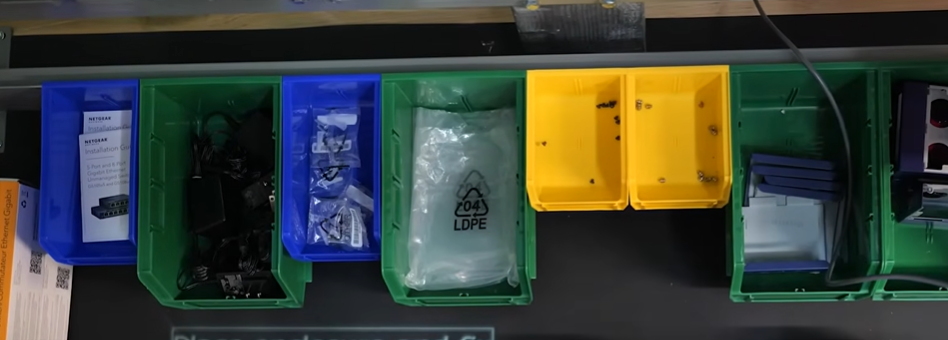
Video frames are analyzed in real time using neural object detection models trained to recognize screws, bolts, fasteners, hand tools, circuit boards, housings, and fixture clamps. For example, when assembling an automotive Electronic Control Module (ECM), the model verifies the metal housing, internal PCB, gasket seals, and assembly screws.
3. Assembly Step Validation
Once target objects are detected, spatial and sequential logic checks whether assembly rules have been satisfied. Interlocking rules can be configured so that if a required fastener or component is not detected in the fixture, the workstation software prevents the process from advancing. If an item is missing or misaligned, visual cues alert the operator immediately.
Note: For assembly parameters that cannot be verified purely through visual cameras—such as verifying exact fastener tightening torque or electrical circuit resistance—the vision system integrates directly with smart torque tools or electrical test benches.
4. Digital SOP Integration
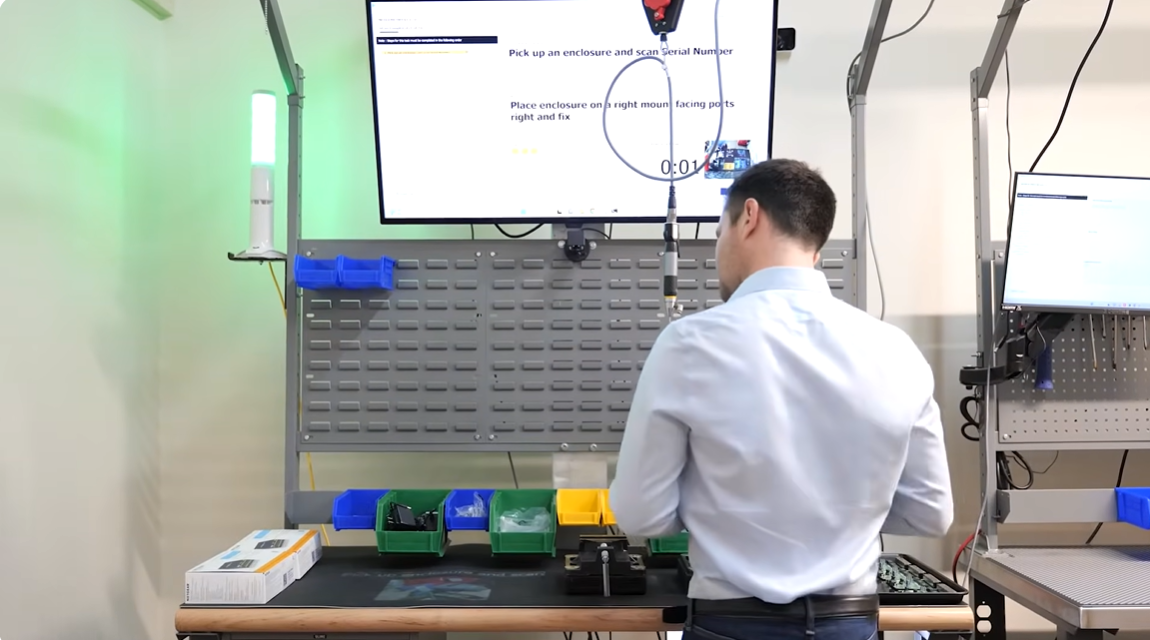
Digital SOPs define the single source of truth for how the assembly must proceed. Each step specifies instructions, reference images, required parts, and completion criteria. The AI compares real-time workstation conditions against this digital definition.
For example, a typical mechanical assembly digital SOP includes:
- Base enclosure placed into the assembly fixture.
- Secondary sub-component inserted into housing.
- Fasteners placed in designated threaded holes.
- Fasteners torqued and verified.
- Final visual inspection and serial barcode scan.
5. Real-Time Operator Dashboard
Workstation displays give operators clear, intuitive guidance on what step is active, what needs to be performed next, and what has been successfully verified. Line supervisors gain visibility into common cycle-time delays and discrepancies where operator training may be needed.
Real-World Example: Automotive Assembly Workstation
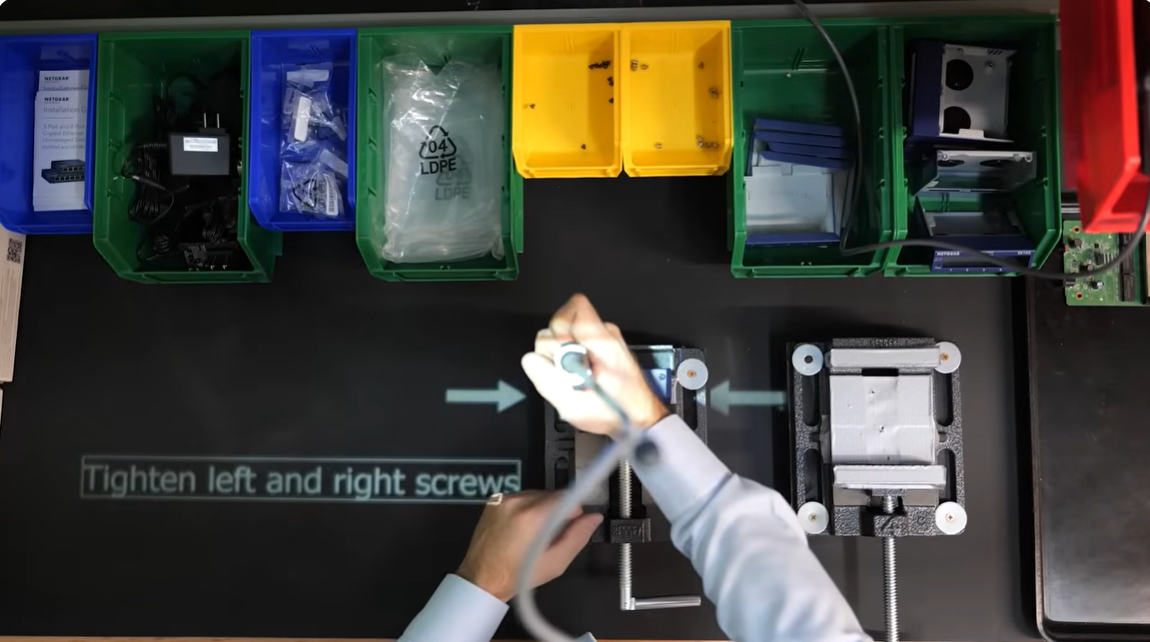
Consider an automotive component workstation where an operator builds an electronic throttle housing. The workstation contains an assembly fixture, multiple component bins, fasteners, and a calibrated torque driver.
Here is how the automated AI tracking workflow operates:
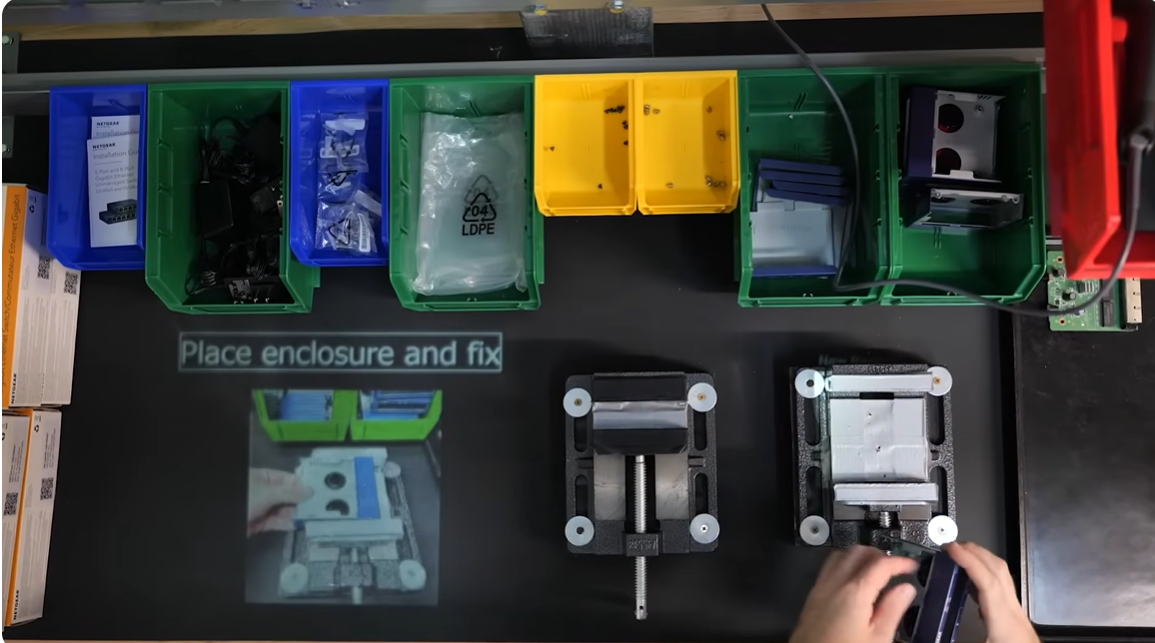
- Component Placement: The operator places the primary enclosure into the fixture. Computer vision instantly verifies that the enclosure is correctly seated.
- Secondary Component Insertion: The operator inserts the internal circuit board. The vision system confirms orientation and pin alignment.
- Fastener Placement & Driving: Screws are picked from color-coded bins and driven. Real-time projected overlays highlight target screw locations.
- SOP Step Validation: The AI verifies that all fasteners are present. If a screw is omitted, the dashboard halts progression and highlights the missing coordinate.
- Assembly Completion: Once all conditions are validated, the system updates the digital record and releases the pneumatic fixture clamp.
Benefits of AI Assembly Tracking
- Improved Accuracy: Automated visual verification identifies missing fasteners, incorrect component variants, or incomplete assembly conditions, slashing downstream rework costs.
- Reduced Human Error: In complex multi-step assemblies, operators can experience mental fatigue. Vision-guided digital SOPs enforce correct assembly sequences.
- Enhanced Visibility: Plant managers and supervisors monitor station throughput, takt time adherence, and step durations via centralized SOP tracking dashboards.
- Consistent Assembly Processes: Standardized digital guidance guarantees that every shift executes assemblies with identical precision.
- Comprehensive Traceability: Every completed step is logged with timestamped validation records, creating a digital genealogy for warranty and quality audits.
- Boosted Shop-Floor Efficiency: Catching assembly defects at the workstation eliminates costly teardowns at end-of-line testing.
- Data-Driven Continuous Improvement: Aggregated cycle telemetry highlights bottlenecks, common operator errors, and opportunities to refine workstation layout.
Manual monitoring relies on periodic supervisor audits, paper checklists, and end-of-line sampling. When production scales, manual oversight cannot maintain 100% inspection coverage. AI Assembly Tracking operates continuously on every cycle, automating inspection while freeing human experts to focus on complex problem-solving.
Industries Where AI Assembly Tracking Excels
AI Assembly Tracking delivers proven value across discrete and hybrid manufacturing sectors:
- Automotive Manufacturing: Engines, electronic control modules, steering columns, and wire harnesses.
- Electronics & PCB Assembly: Multi-connector seating, surface-mount components, and enclosure fastening.
- Mechanical Equipment: Gearboxes, hydraulic pump assemblies, and motor sub-assemblies.
- Industrial Machinery: Complex machinery assemblies with high component counts.
- Consumer Appliances & Products: High-volume repetitive consumer products requiring first-pass yield.
Key Engineering Considerations for Deployment
When implementing vision-based assembly tracking, engineering teams should evaluate:
- Lighting Consistency: Stable, diffused illumination prevents glare on metallic fasteners and polished plastics.
- Hand & Tool Occlusion: Positioning dual cameras or configuring multi-frame temporal logic ensures hands do not block critical verification moments.
- Component Discrimination: Differentiating between visually similar screws or brackets requires curated training datasets.
- Tool & MES Interfacing: Connecting vision inferences with smart tool controllers and enterprise MES systems ensures seamless line interlocking.
AI Vision & Digital SOPs in Smart Manufacturing
Smart manufacturing relies on connecting physical shop-floor actions with intelligent digital workflows. By uniting computer vision with interactive digital SOPs, manufacturers transform static work instructions into active, closed-loop quality systems.
Coupled with automated AI quality inspection and Smart Factory Solutions, AI Assembly Tracking forms the foundation of zero-defect autonomous operations.
How YAFE Can Help with AI Assembly Tracking
YAFE specializes in enterprise industrial AI solutions that transform manufacturing efficiency and plant safety. Our AI Assembly Tracking and SOP Tracking platforms are built for high-speed production environments, offering:
- Sub-15ms edge computer vision inference for real-time operator feedback.
- Automated tracking of parts, fasteners, and tool interactions.
- Seamless integration with existing shop-floor cameras and digital screens.
- Closed-loop interlocking with PLC line stops and smart tooling.
- Centralized MES analytics for cycle times, bottlenecks, and first-pass yield.
Explore how YAFE can optimize your assembly operations by visiting our Smart Factory Solutions Overview or scheduling a live technical demonstration.
Conclusion
AI Assembly Tracking is revolutionizing manufacturing quality by pairing computer vision with digital standard work. By providing real-time visual feedback, enforcing sequence compliance, and capturing digital genealogy, industrial plants eliminate rework and achieve consistent zero-defect output.
Frequently Asked Questions (FAQ)
1. What is AI Assembly Tracking?
AI Assembly Tracking uses cameras, computer vision, and rule logic to monitor assembly processes. It identifies components, tools, and fasteners in real time to verify that each assembly step meets required standard work conditions.
2. How does computer vision help with assembly monitoring?
Computer vision analyzes continuous video streams to detect part placements, verify tool usage, and check visible assembly states against digital SOP criteria without requiring physical contact.
3. Can AI identify if a screw or bolt is missing?
Yes. When trained on your components, computer vision detects whether fasteners are present in designated coordinates. The vision system can also integrate with torque drivers to verify both visual presence and tightening torque.
4. What is the role of digital SOPs?
Digital SOPs provide the interactive visual definition of each assembly stage, guiding the operator on what to build while providing the AI with the baseline conditions needed for step verification.
5. Can assembly tracking help reduce errors?
Yes. By enforcing step sequences and validating component presence before line progression, AI assembly tracking prevents skipped steps, incorrect part variants, and unfastened joints.
6. Can AI Assembly Tracking be used within automotive manufacturing?
Extensively. Automotive plants use AI assembly tracking for wire harnesses, engine sub-assemblies, electronic modules, and instrument panels to guarantee Poka-Yoke compliance.
7. Can AI Assembly Tracking be integrated with an MES?
Yes. YAFE integrates via standard industrial protocols (MQTT, OPC-UA, REST APIs) to feed real-time cycle times, station bottlenecks, and pass/fail states into enterprise MES and ERP platforms.
8. What is the difference between assembly tracking and quality inspection?
Assembly tracking monitors the ongoing assembly process to ensure all steps occur in proper order. Quality inspection verifies that the final assembled component meets dimensional, aesthetic, and functional specifications. Both work together in modern smart factories.